
What's new
Danish mysticism – Rued Langgaard Festival 2025
In this year’s Rued Langgaard Festival, we take a close look at the first decades of the 20th century, when there was a fervent interest in alternative religious, occult and theosophical movements in Denmark. This was also true for several composers of the time: Ludolf Nielsen, Tekla Griebel Wandall and Rued Langgaard.
In the concert piece The Star in the East, Rued Langgaard pays tribute to a theosophical order that believed in the imminent return of Christ. The Freemason Ludolf Nielsen, who originated from the Næstved region, wrote enchanted music with Skovvandring, which linked supernatural, ancient creatures with the trolls, lantern men and elf girls of Nordic folk mythology. In the 1890s, Tekla Griebel Wandall wrote songs about the magical moods that can arise when day and night meet.
Hidden forces in music
Common to all three composers is a belief in mysticism, that there are hidden forces in the world that we can sense and activate through music. For Tekla Griebel Wandall, these beliefs led her, late in life in the 1930s, to write the music-theoretical work The Microcosm of Tones, which is based on a theosophical foundation and the idea that music is a representation of the universe. She is thus related to Rued Langgaard, who until his death was involved in the “Mission of Music” and who earlier in his manuscript Fremtidens Frelser og Jesu musikalske Selskab described a future religious society where art and the church have merged.
Mysticism in music
Over the four days of the festival, we will play a number of the three composers’ most striking works that explore mysticism in different ways. Pianist Kristoffer Hyldig plays Langgaard’s Insektarium and the late piano sonata Le Beguinage, where devilish insects and religious fanaticism inspire music that offers both breathless silence and mania. And it is with pride that we can give the first public performance of Rued Langgaard’s last work, Fra Dybet , at the traditional concert with Sønderjyllands Symfoniorkester. With quotes from the Catholic Mass of the Dead and inspired by a Breton legend in which the bells of a city sunk in the sea are heard, From the Deep is a kind of personal requiem.
From horror to peace
Chamber music can be experienced in Sct. Catharinæ church, where there is also vocal music. Some of Ludolf Nielsen’s most sensual songs are presented here, and with Tekla Griebel Wandall’s Lenore, you can expect gothic eeriness of a romantic nature. The festival ends on a softer note with Tekla Griebel Wandall’s Fred! for solo voices and women’s choir and an arrangement for Esbjerg Ensemble, created for the occasion by Jonas Hunt.
Langgaards Eftermiddag
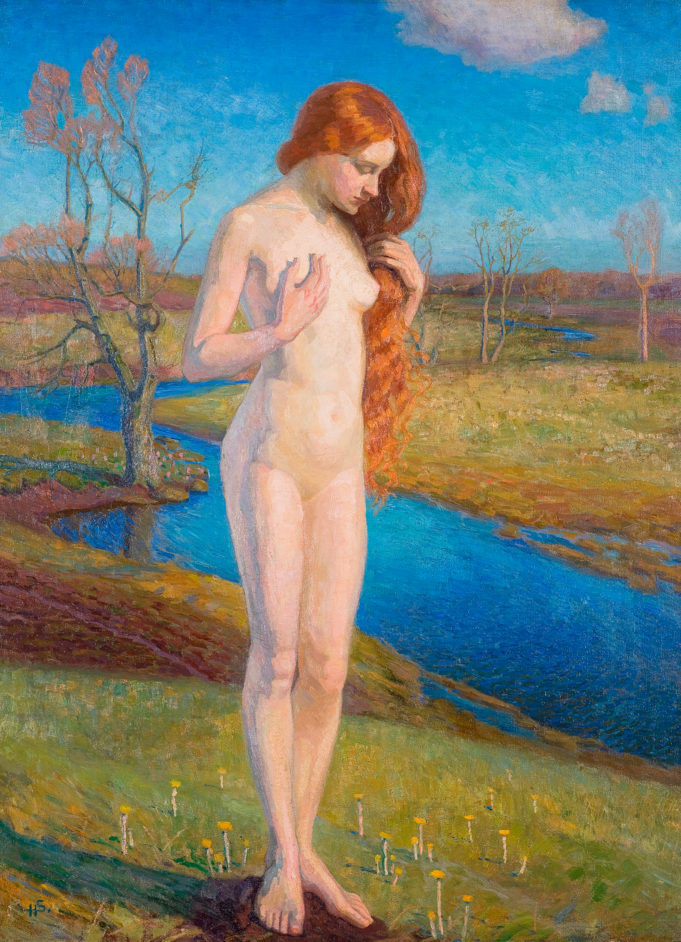
As in the last two years, Ribe Art Museum is also involved in the Rued Langgaard Festival with a poetic traveling concert. Over two afternoons, a personal interpretation of Antichrist comes into play together with Stravinsky’s Sacre du Printemps. Jakob Kullberg, cello, and Jacob Kirkegaard, sound art, immerse themselves in the dual nature of the Antichrist, and sisters Astrid and Katrine Grarup Elbo worship the earth with ritual dance and music in the art museum garden. Inside the museum, Ursula Andkjær Olsen performs a poetic text in dialog with the festival’s image of the year: Henrik Schouboe: Spring
Klange at the cemetery
Finally, we venture into the urban space under the heading Langgaard’s bench. At a total of four events, two of which take place at Ribe Gamle Kirkegård, Niels Lyhne Løkkegaard will let the reverberations of Langgaard’s atmospheric Ribe, tidlig Morgen merge with the sounds of the city and nature. And in dialog with a reading by Jonas Eika of Open Sky. A new book in which Eika – like Langgaard – is inspired by the Beguine Christian women’s movement, and where mystical visions of the young Virgin Mary are connected to a life here and now.
Esben Tange


